
There’s smiles all around for one local group who have won an impressive and prestigious film award – The Iris Prize.
The Standards of Wrexham’s Services (SWS) is a group of individuals who have been diagnosed with a disability and are supported by Wrexham Adult Social Care received the Best Community Short Film for “We Leave Our Labels at the Door” at a recent ceremony in Llandudno.
The Iris Prize was established in 2007 by The Festivals Company, as an international lesbian, gay, bisexual, transgender (LGBT) film prize for any film which is of interest to LGBT audiences. It’s open to filmmakers from around the world and judged by a panel of international artists and filmmakers.
The SWS group received the award for Best Community Short Film. The Awards celebrate the achievements of organisations across Wales, including schools, workplaces and community groups, who over the past year have worked with Iris to make a short film exploring LGBT+ issues.
Nicole Mitchell-Meredith, Person Centred Planning Coordinator who works with the Standards of Wrexham’s Services (SWS) group, said: “We at the SWS are absolutely thrilled to have won this award! They wanted to support people with disabilities to express their sexuality in a safe and informed manner.
“We hope this film goes some way to accomplish this. Everyone has worked very hard and to receive such prestigious recognition is very encouraging for those involved and to the wider LGBT community in Wrexham. I would like to take this opportunity to thank everyone involved and to encourage the SWS and Iris to continue with their excellent work.”
The group recently met the Mayor of Wrexham, Cllr Andy Williams, who congratulated them on their achievement.
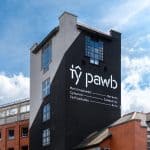
Hundreds of people of all ages flocked to Tŷ Pawb on Saturday for a huge celebration of Welsh music.
As well some brilliant live performances from some of the best Welsh acts around, the day also included live choirs and theatre, a film screening, arts and crafts for children, a huge Magi Ann party and live rugby on the big screen!
Then came a stirring performance from the choir of Lleisiau Clywedog, who encouraged the audience to join in with some traditional rugby warm up songs – Sospan Fach and Calon Lan!
Other highlights from the day included a vlogging workshop, artist talk with Elis Derby, a screening of Huw Stephen’s excellent film, Anorac, and an enormous Magi Ann party which attracted close to a hundred children and parents!
We also held a very special edition of our weekly Saturday morning Family Art Club, inspired by their favourite Welsh bands! We love the results!
A gig to remember
With the first part of the day over, we moved onto the rugby. Italy v Wales on Tŷ Pawb’s big screen in a packed People’s Square! A narrow win, but still a win! England are next! You can watch this game at Tŷ Pawb next Saturday at 4.45pm.
As soon as the final whistle had blown, the big screen lifted to reveal the main stage for the evening gig, organised by the Focus Wales team.
Four top Welsh bands performed to a delighted audience with a real feel-good factor filling the room from start to finish. A wonderful showcase for Wales’ thriving music scene.
Tŷ Pawb’s events manager, Morgan Thomas, said: “We couldn’t have wished for a better day, the whole building was buzzing from start to finish.
“What really delighted us was seeing the different activities blending together. The Criw Celf children sitting in front of the stage sketching the bands, families staying to watch the rugby after the craft events and having a wander round the markets and galleries, eating in the food court and getting a drink at the bar. It really was a day for everyone.
“The bands and the audience were just fantastic. A real mix of bold, fresh and exciting sounds that really showed off why Welsh music is so good at the moment.
“We’ve had some amazing feedback from those involved already. We’ll definitely be looking to do this again!”
Staff and pupils at Acton Park Primary School have lots to celebrate following a successful follow-up Estyn Inspection report. The report sees the school removed from a list requiring significant improvement.
In the report, the inspector says: “Acton Park Primary School is judged to have made sufficient progress in relation to the recommendations following the most recent core inspection.
As a result, Her Majesty’s Chief Inspector of Education and Training in Wales is removing the school from the list of schools requiring significant improvement.”
The report has noted strong improvements in the following areas:
• The introduction of a range of new teaching techniques has had a positive impact on the writing skills of most pupils. • Across the school, many pupils have developed their ability to work independently on their own, in pairs and in groups. • The introduction of ‘tracked books’ has been particularly effective. In each class, teachers assess and review the work of a small group of identified pupils over time to assist with standardising teacher assessment across the school • Staff and leadership meetings focus well on the recommendations from the core inspection and have clear outcomes. • Governors link with specific recommendations arising from the core inspection report. They meet with the staff responsible for each of these areas on a regular basis to develop their understanding of the progress the school is making. • Since the core inspection, staff have received a range of valuable professional learning opportunities to improve their knowledge and understanding of how to develop pupils’ literacy and numeracy skills effectively across the curriculum.
“Hard work and dedication”
Mr. Peter Cuff, chair of governors, spoke on behalf of the school and said; “Our children, parents, staff and governors have all been involved in our school improvement. Knowing that it was not a marginal decision to remove Acton Park from the list of schools requiring significant improvement is testament to the hard work and dedication of all involved. There is lots to celebrate and, whilst we will continue on our journey to ensure the very best learning opportunities for our children, we are very pleased that Estyn feel that we clearly have the capacity to do so”.
Cllr Phil Wynn, lead member for education, said: “Congratulations are due to all staff, pupils and governors for their efforts in ensuring the school has delivered against Estyn’s recommendations by the time of the second inspection. The reinvigorated working of staff and governors, which I have observed first-hand over the last eighteen months, provides me with confidence that the school will continue to flourish”.
Ian Roberts, head of education at Wrexham Council, congratulated the school for its “excellent outcome” following the Estyn visit and praised everyone for their “effort, commitment and dedication.”
Plas Pentwyn in Coedpoeth will be opening its doors on March 13 to some exciting Welsh musicians to promote new Welsh talent in a rural community environment.
The event takes place on March 16 and starts at 7.30. Tickets are just £10 each.
Blodau Papur will be headlining the event. A very talented Welsh medium band featuring Alys Williams who was chosen by Sir Tom Jones on The Voice on series 2!
The supporting acts are Elan Catrin Parry, who signed a record deal after being spotted singing in the Eisteddfod, and 15 year old guitarist Ifan Owen, both attend Ygol Morgan Llwyd and both look to have bright futures in the music industry.
Elan’s already making a name for herself as you can see from this video
Stephen Jones, Welsh Language Coordinator with us said: “There’s so much talent in Wrexham and it’s beginning to get the publicity and promotion it deserves. Bilingual events are always very well supported and it’s great to see a community outside the town centre coming together to support their local musicians and singers. I wish them luck.
“We’re always happy to help promote bilingual events in Wrexham and if you want further information about how we can assist please contact cymraeg@wrexham.gov.uk.
There’s an event on Wednesday that aims to encourage us all to talk to others about mental health and how we can be helped and help others.
We’ve been working with the Department of Work and Pensions to bring the “Time to Talk” event to Wrexham. It takes place between 11am and 2pm.
One in four of us are affected by mental health issues but are reluctant to talk about it so why not drop in to see what’s available to you or your friends and family.
There will be over 20 stalls full of information and advice and there will also be organisations on hand to help you improve your mental health and well-being.
Cllr Joan Lowe, Lead Member for Health and Adult Social Care, said: “It’s important we all take time to look after ourselves and this event will bring together mental health organisations whose staff will be happy to give information and answer any questions you may have. So just pop along take a look at what’s going on and take time out to see if any of the organisations can help you.”
Local residents of Trevor may have noticed machinery that has been working in the woodland near to the community centre. A much desired new path is being created in Rhos y Coed which will link together the Community Centre in Trevor to the Canal near Postles Bridge. Many residents have been hoping for a path through this woodland for a number of years and are pleased that their wishes are coming into fruition.
The path will provide a direct link for the community to the World Heritage site though a former industrial area where nature has taken over and woodland has naturally regenerated. The new route has been christened ‘The Clinker Path’ as it features a large clinker boulder beside the canal, a dramatic reminder of the industrial past, there are also several smaller clinker boulders within the woodland. Clinker is the waste product from the smelting process in the iron industry.
The giant meteorite like large clinker boulder may also be easily mistaken for a tree root plate and many people will have passed by without understanding the significance of its existence. The plan is to clear the vegetation around the clinker and provide some interpretation and a bench for quiet canal-side contemplation. Initially sections of the path will have a base surfacing which will be allowed to settle for 12 months, after that a top layer will be applied. There will also be some mitigation tree planting 3 saplings for every mature tree that has been cut down to enable the path to go through the woodland.
‘Our Picturesque Landscape”
This new path has been made possible by the Heritage Lottery Funded project ‘Our Picturesque Landscape’ (OPL) which centres on the landscape of the Dee Valley and the Pontcysyllte Aqueduct and Canal World Heritage Site. It takes the theme of inspirational journeys that have been, and continue to be, a feature of the area which is cut by the canal, Telford’s A5 and the River Dee. The five year project will invest in the resilience of key visitor sites and engage communities in its appreciation and management while reinterpreting this rich landscape for a new generation. The story of the clinker and how it came to be where it is found today is still a bit of a mystery and the OPL team would be grateful for any help in finding out more about it.
“Llangollen Rural Community Council and The Aqueduct Community Association agreed that they are excited that the long dreamed of path in Rhos y Coed Wood is finally happening and are looking forward to being able to walk through and enjoy the woodland.”
A Wrexham night-life scheme designed to keep staff and customers safe – and celebrate excellence in the industry – has won a national award.
Wrexham Best Bar None was named the most innovative scheme of 2018 at the National Best Bar None Awards, which took place at the House of Lords earlier this week.
So what’s the deal?
Best Bar None is a national scheme supported by the Home Office and the drinks industry. It’s mostly aimed at promoting the responsible management of clubs, pubs and other alcohol-licensed premises – to help keep towns and cities safe for both staff and people enjoying a night out.
It’s been adopted by 75 towns and cities across the UK and is now being used in other countries too.
The aim is to reduce alcohol-related crime and disorder by building stronger links between the licensed trade, police and local councils – so they can share knowledge, ideas and good practice.
Businesses have to meet minimum standards to be recognised by the scheme, including a ‘rigorous’ audit of over 120 criteria – covering everything from responsible management to customer care.
The award for ‘Most Innovative Scheme’ is given to the project with the most creative approach to making a difference in their local area.
There were six other schemes shortlisted in England and Wales, and Wrexham was awarded top spot because of the wide range of initiatives to improve safety – including awareness training for licensees and door staff on how to spot and help customers who might be vulnerable, and approaches to counter terrorism.
Judges gave Wrexham particular praise for the strong partnership between the council, North Wales Police, North Wales Fire Service, licensees and security – working together to deliver results with very limited resources.
Cllr Mark Pritchard, Leader of the Council said:“It is great to see that of the 75 towns and cities in the UK who have adopted the Best Bar None scheme, Wrexham has been recognised as “Best Bar None Most Innovative Scheme 2018.
“This really is fantastic news for us. What this highlights is the hard work, dedication and support that exists across our night time economy by partners to ensure Wrexham is a safe place for people wanting to enjoy a night out.“
Chief Inspector Mark Williams said; “ I am really pleased to hear that the Wrexham Best Bar None Scheme has been recognised for its innovative approach. The partnership between the licencing authorities, the emergency services and the licensees in Wrexham has gone from strength to strength over the years. A safe and welcoming town centre benefits all and we will continue to work together to ensure we continue to achieve our objectives.”
If you run a licenced premises and want to know more about the Wrexham Best Bar None scheme, contact communitysafety@wrexham.gov.uk
For our next instalment of ‘five interesting things about places in Wrexham County Borough’, we’ve decided to take a look at Borras.
Borras, like many of the other places we’ve covered, has a wealth of history, and our first pick covers some of this.
So, without further ado, here’s our five interesting things…
1. Neolithic settlement
Following the end of the last Ice Age (somewhere around 8000BC), Mesolithic people would travel around North-East Wales through rivers.
They were hunter-gatherers, living as nomads in wooded landscape, and there’s evidence of them being in the Borras area, as small flint tools (known as microliths) have since been discovered.
Then towards the Neolithic period (c.4300 – 2300BC), people began settling in farming communities.
They would build structures known as long barrows, and they would clear woodland using stone axes…examples of these have also been found in Borras, indicating a settlement.
These finds have received plenty of media coverage over the past decade, such as in this BBC News article.
You probably already know there was a Royal Air Force base at Borras, which was used during both World Wars.
During 1917-20, the base was used by Number Four and Number 52 Training Squadron Schools of the Royal Flying Corps.
Then, during the Second World War, the three grass runways were used as relief landing strips, with visits from several training squadrons such as Spitfires from the nearby RAF Ternhill.
It was later upgraded to have concrete runways, with lighting also being installed, and in 1941, Number 96 Squadron arrived in Wrexham.
From 1941-44, Number 285 Squadron were based in Wrexham for training exercises and the base was also used by the US Army to support their units close by.
Due to the extensive history of the RAF in Wrexham, the centenary celebration of the RAF in Wales took place at Queens Square last year. Here’s our video from the event 🙂
3. Nuclear bunker
This next selection is on the same site as the airfield, as between 1962 and 1992, a hardened nuclear bunker was built here for No 17 Group Royal Observer Corps North Wales.
This was during the Cold War, where a four-minute warning would’ve been sounded to warn the people of Wrexham in the event of a radioactive fallout.
Eighty volunteers manned the building at the time, but when the potential threat subsided, this was no longer required.
The nuclear bunker still stands on the site of RAF Wrexham, but it’s since been converted and is now used as a recording studio.
4. Borras Hall
Borras Hall is a stunning early 17th century former manor house.
It’s thought that it replaced an early 13th century house on the same site, as in 1988, an item believed to belong to the lords of Borras and Erlas – who built Plas ym Mwras in around 1200 – was discovered.
It stands now as a two-storey building, partly timber framed, encased in red brick and with a slate roof.
It’s really beautiful to look at, and interestingly some of the later brick additions once housed dairy and cheese making facilities.
5. The other Borras
Did you know that there’s a city in Sweden called Borras? Well nearly anyway, it’s actually spelt Boras.
Boras is in the region of Västra Götaland, over 200 mile south-west of Stockholm.
The city’s ‘coat of arms’ depicts two pairs of sheep shears, which is a tribute to the vast number of smiths from its early history.
The football team IF Elfsborg hail from here, and they play their matches at Boras Arena.
Another fun fact is that every summer in Boras, a number of free outdoor concerts are held on Thursday evenings.
Sounds like a cool place too 🙂
We hoped you enjoyed this edition of ‘five interesting things’. And as always, stay tuned for the next one.
There aren’t many people fortunate enough to say they live in a country that possesses a language with as rich a historical background as us Welsh folk do. As time passes however the importance of our language is sadly at risk of becoming forgotten.
Thankfully in 2016 the Welsh government addressed this issue by introducing Welsh Language Standards to all public organisations. This was to ensure that the Welsh language is no longer treated less favorably to English.
That’s right – the Welsh language is on its way up! But it needs your help.
In order to provide equal Welsh language opportunities for speaking residents it’s essential that the council identifies their preferred methods of communicating and accessing information. Completing this survey can help the Welsh government achieve this.
Clir Hugh Jones, Lead Member for Communities, Partnerships, Public Protection and Community Safety said “I’d like to encourage all Welsh speakers to take part in completing this survey. These are exciting times for the Welsh language and it’s vital that we all do our part to further its progress.”
Completing this survey may not seem like a grand contribution towards the betterment of the Welsh language… but the combined efforts of you and other Welsh speakers will act as a great step towards the progress of our illustrious language.
A private landlord operating in Wrexham has been prosecuted for not complying with an Improvement Notice to deal with poor conditions served by the Council’s Environmental Health and Housing Standards team. The court imposed fines and costs totaling £2,295.
Cllr David Griffiths, Lead Member for Housing said: “The Council is proactively working with landlords to assist them and raise standards for tenants. But if they choose not to cooperate and comply with the legal requirements, we will have no hesitation in taking firm enforcement action as a recent case demonstrates.”
You can find a list of the hazards that the council will investigate here
Most landlords do carry out repairs once they know about them. However, if your landlord fails to carry out the repairs after a reasonable period of time, you should contact Environmental Health and Housing Standards on HealthandHousing@wrexham.gov.uk or on 01978 292040.